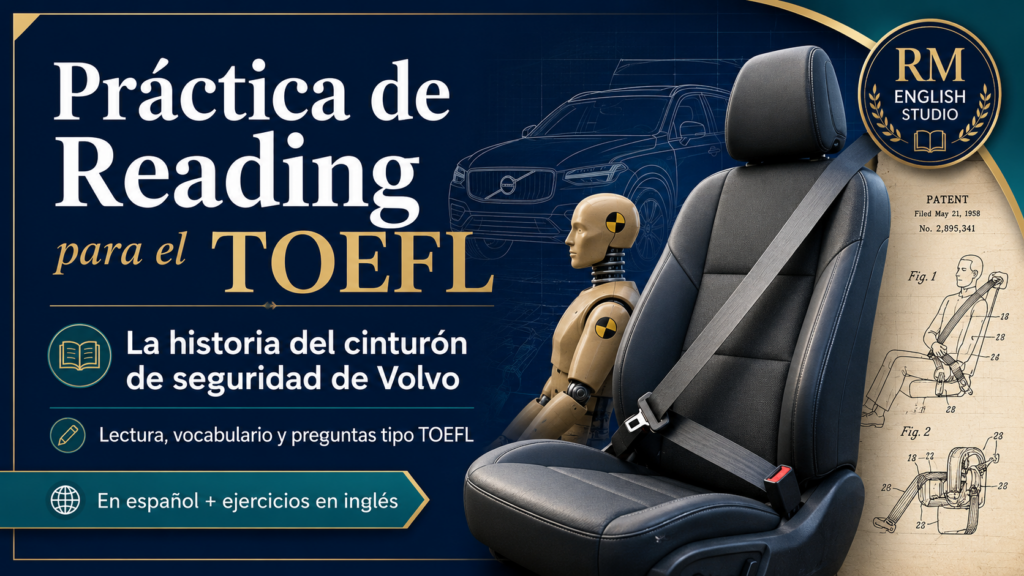
Hay textos que funcionan especialmente bien para practicar comprensión lectora porque combinan historia, innovación, decisiones empresariales y consecuencias sociales. La historia del cinturón de seguridad de tres puntos de Volvo es uno de ellos.
Además de ser un tema interesante por sí mismo, permite trabajar varias de las habilidades que aparecen con frecuencia en la sección de Reading del TOEFL: identificar la idea principal, localizar información específica, inferir información, reconocer vocabulario por contexto y entender por qué el autor incluye determinados detalles.
En esta lección vamos a utilizar la historia de Nils Bohlin y Volvo como base para practicar estas estrategias.
Antes de leer: predecir el tema
Una buena estrategia antes de comenzar una lectura académica consiste en observar el título, identificar palabras clave y anticipar qué tipo de información probablemente aparecerá en el texto.
Por ejemplo, si vemos estas palabras:
- Seat belt
- Crash test
- Engineer
- Patent
- Volvo
- Safety
podemos anticipar que el texto probablemente estará relacionado con seguridad automotriz, ingeniería, innovación y propiedad intelectual.
Esta predicción inicial no tiene que ser exacta. Su objetivo es activar conocimientos previos y preparar al lector para reconocer ideas importantes más rápidamente.
Vocabulary Preview
Antes de leer, intenta relacionar estas palabras con sus significados.
- remarkable
- adequately
- restrain
- exerted
- intuitive
- voluntary
- restricted
- reputation
- sophistication
- innovation
A. done by choice, not by force
B. a new idea, method, or invention
C. controlled or prevented from moving freely
D. unusual and worthy of attention
E. forcefully applied or put into action
F. great skill, complexity, or refinement
G. sufficiently or properly
H. easy to understand or use naturally
I. limited or not freely available to everyone
J. the opinion people generally have about someone or something
No intentes traducir necesariamente cada palabra. En el TOEFL es mucho más importante poder reconocer su significado dentro del contexto.
Reading Passage
The Invention That Volvo Gave Away
[1] Some inventions are remarkable because of their technological complexity, while others are significant because they solve a serious problem with extraordinary simplicity. The modern three-point seat belt belongs to the second category. Its basic form is familiar to almost everyone: one section crosses the chest diagonally, while another lies across the pelvis. Although this arrangement may now appear obvious, it was the result of careful engineering. More unusually, the company responsible for the design chose not to keep its safety advantages exclusively for itself. Instead, Volvo allowed other automobile manufacturers to use the invention, helping transform it into a universal feature of modern vehicles.
[2] Before the three-point seat belt was introduced, some vehicles were equipped with two-point lap belts. These belts passed across the waist and could prevent passengers from being thrown completely out of a car. However, they did not adequately restrain the upper body. During a collision, a passenger’s chest and head could continue moving forward with tremendous force. In some circumstances, the lap belt itself could cause serious internal injuries because the impact was concentrated around the abdomen. Engineers therefore faced a difficult challenge: they needed to create a system that distributed the force of a crash across stronger parts of the human body without making the device so uncomfortable or complicated that passengers would refuse to use it.
[3] In 1958, Volvo hired Swedish engineer Nils Bohlin to work on automotive safety. Bohlin had previously worked in the aviation industry, where he helped develop ejection seats for aircraft. This experience gave him a detailed understanding of the forces exerted on the human body during sudden, violent movement. Nevertheless, protecting the occupant of a family car presented a different kind of problem. An aircraft restraint system could be relatively complex because pilots were trained professionals. A seat belt for ordinary motorists, by contrast, had to be convenient, intuitive, and easy to fasten with one hand.
[4] Bohlin’s solution combined a lap belt with a diagonal shoulder belt in a single continuous system. The belt was anchored at three points and formed a V shape across the occupant’s body. This design helped hold both the upper and lower body in place. More importantly, it directed the force of an impact toward the chest and pelvis, which are better able to withstand pressure than the abdomen. The positioning of the belt also reduced the likelihood that a passenger would slide underneath it during a collision. Bohlin later emphasized that an effective safety device had to protect people while remaining simple enough for them to use voluntarily.
[5] Volvo introduced the three-point seat belt as standard equipment in certain Swedish models in 1959. At the time, however, public acceptance was far from guaranteed. Many drivers considered seat belts unnecessary or even dangerous. Some believed that they would prefer to be thrown from a vehicle during an accident rather than remain trapped inside it. Others regarded safety belts as uncomfortable restrictions on personal freedom. Consequently, producing an effective device was only part of Volvo’s task. The company also had to persuade the public that wearing it was both rational and desirable.
[6] Volvo could have treated the three-point belt as a competitive advantage and restricted its use by other manufacturers. Such a decision might have strengthened the company’s reputation for safety and increased the commercial value of its vehicles. Instead, Volvo made the design available to the wider automobile industry without demanding the licensing fees that ordinarily accompany a valuable patented invention. The company concluded that the potential to save human lives was more important than maintaining exclusive control over the technology. As other manufacturers adopted the design, the three-point seat belt gradually became an international standard.
[7] This decision is frequently presented as a striking example of corporate responsibility. Businesses are generally expected to protect their intellectual property because patents allow them to recover research expenses and profit from innovation. From this perspective, giving competitors access to a major invention may seem economically irrational. Nevertheless, Volvo’s choice also produced long-term benefits for the company. By associating its name with safety, the manufacturer established a reputation that became central to its identity. Thus, the decision was not necessarily a rejection of commercial interests. Rather, it demonstrated that ethical action and business strategy can sometimes reinforce one another.
[8] The history of the three-point seat belt also illustrates that an invention’s value cannot be measured solely by its technical sophistication. Bohlin did not create the first restraint system, nor did his design eliminate every risk associated with automobile travel. His achievement was to improve existing ideas and combine effectiveness with ease of use. Volvo’s contribution went beyond engineering because the company helped ensure that the invention could be adopted broadly. The familiar click of a seat belt is therefore more than an ordinary part of entering a car. It is a reminder that a simple design, supported by an unusual corporate decision, can alter human behavior and save lives on a global scale.
TOEFL Reading Practice
Ahora responde las siguientes preguntas sin volver inmediatamente al texto. Luego regresa al pasaje y busca evidencia para confirmar cada respuesta.
1. What is the main purpose of the passage?
A. To explain why automobile companies compete over safety technology
B. To describe the development of the three-point seat belt and the significance of Volvo’s decision
C. To compare modern cars with aircraft used during the 1950s
D. To argue that patented inventions should always be made public
2. According to paragraph 2, what was a major weakness of two-point lap belts?
A. They were too difficult for passengers to fasten
B. They prevented passengers from leaving the vehicle
C. They did not adequately restrain the upper body
D. They placed excessive pressure on the chest and pelvis
3. The word “exerted” in paragraph 3 is closest in meaning to:
A. avoided
B. applied
C. measured
D. reduced
4. Why does the author mention Bohlin’s previous work with aircraft ejection seats?
A. To explain why Volvo originally intended to manufacture aircraft
B. To show that Bohlin understood how violent movement affects the human body
C. To demonstrate that aircraft restraints were safer than automobile seat belts
D. To suggest that pilots helped design the three-point seat belt
5. According to paragraph 4, why was the V-shaped design more effective?
A. It concentrated the force of a collision on the abdomen
B. It allowed passengers to remove the belt more quickly
C. It directed impact forces toward stronger parts of the body
D. It prevented the vehicle from moving during a collision
6. What can be inferred from paragraph 5 about public attitudes toward seat belts in 1959?
A. Most drivers immediately accepted the new technology
B. Some drivers misunderstood the dangers of automobile accidents
C. Drivers believed seat belts should be used only by professional motorists
D. Most people wanted governments to require seat belt use
7. The word “restricted” in paragraph 6 is closest in meaning to:
A. improved
B. advertised
C. limited
D. examined
8. Why did Volvo allow other manufacturers to use the three-point seat belt design?
A. The company believed that saving lives was more important than exclusive control
B. The company had failed to obtain a patent for the invention
C. Other manufacturers threatened to create a similar design
D. Government authorities required Volvo to share the technology
9. What does paragraph 7 suggest about the relationship between ethical decisions and business interests?
A. Ethical decisions usually prevent companies from making a profit
B. Companies must choose between public safety and commercial success
C. Ethical action can sometimes strengthen a company’s commercial reputation
D. Patents are unnecessary when a company has a strong public image
10. Which of the following best expresses the essential information in the following sentence?
“His achievement was to improve existing ideas and combine effectiveness with ease of use.”
A. Bohlin created an entirely new restraint system that was more complex than previous designs.
B. Bohlin made an existing concept safer while ensuring that ordinary people could use it easily.
C. Bohlin demonstrated that simple inventions are always more successful than sophisticated ones.
D. Bohlin replaced all previous automobile safety devices with technology from the aviation industry.
Answer Key
- B
- C
- B
- B
- C
- B
- C
- A
- C
- B
¿Qué habilidades del TOEFL estamos practicando?
Estas preguntas no evalúan todas la misma habilidad.
Las preguntas 1 y 9 requieren comprender ideas generales y relaciones entre conceptos. La pregunta 1 es una típica pregunta de main idea. No basta con encontrar una oración específica: hay que identificar qué explica el texto en conjunto.
Las preguntas 2, 5 y 8 son preguntas de factual information. La respuesta aparece directamente en el texto, aunque puede estar expresada con palabras diferentes.
Las preguntas 3 y 7 son de vocabulary in context. En este tipo de pregunta, no conviene elegir una definición simplemente porque conocemos la palabra. Hay que comprobar cuál significado funciona específicamente dentro de esa oración.
La pregunta 4 evalúa author’s purpose. Debemos preguntarnos por qué el autor decidió mencionar una información determinada. En este caso, la experiencia de Bohlin con los asientos eyectables ayuda a explicar por qué tenía conocimientos relevantes sobre las fuerzas que actúan sobre el cuerpo humano.
La pregunta 6 es de inference. El texto no dice literalmente que algunos conductores “misunderstood the dangers of automobile accidents”. Sin embargo, podemos concluirlo a partir de sus creencias sobre los cinturones de seguridad.
Finalmente, la pregunta 10 trabaja sentence simplification o identificación de información esencial. El objetivo es reconocer qué idea fundamental permanece cuando eliminamos los detalles secundarios.
Una estrategia importante: buscar evidencia, no intuiciones
Uno de los errores más comunes en Reading es seleccionar una opción porque “suena correcta”.
En el TOEFL, una respuesta debe estar respaldada por el texto.
Por ejemplo, en la pregunta 8, podríamos imaginar diferentes razones comerciales por las cuales Volvo compartió la tecnología. Sin embargo, el párrafo 6 nos dice específicamente que la empresa consideró que el potencial de salvar vidas era más importante que mantener el control exclusivo de la tecnología.
Esa es nuestra evidencia.
Cuando practiques Reading, intenta crear este hábito:
Answer → Evidence → Confirmation
Primero eliges una respuesta probable. Después localizas en el texto la evidencia que la respalda. Finalmente, compruebas que ninguna de las otras opciones representa mejor lo que realmente dice el pasaje.
¿Qué podemos aprender de esta historia?
La historia del cinturón de seguridad de tres puntos es interesante porque combina dos ideas.
Por un lado, demuestra cómo una innovación relativamente sencilla puede tener un enorme impacto cuando resuelve correctamente un problema humano.
Por otro, plantea una cuestión menos técnica: ¿qué ocurre cuando una empresa posee una tecnología potencialmente beneficiosa para millones de personas?
Volvo decidió facilitar que otros fabricantes utilizaran el diseño. Paradójicamente, esa decisión no eliminó el beneficio comercial para la empresa. Su asociación con la seguridad se convirtió en parte fundamental de su reputación.
Para un estudiante del TOEFL, precisamente este tipo de relación entre tecnología, decisiones empresariales y consecuencias sociales es importante. Los textos académicos del examen suelen exigir algo más que reconocer datos: debemos entender cómo las ideas se relacionan entre sí.
Y esa es una de las habilidades más importantes que debemos desarrollar para mejorar nuestro Reading.